



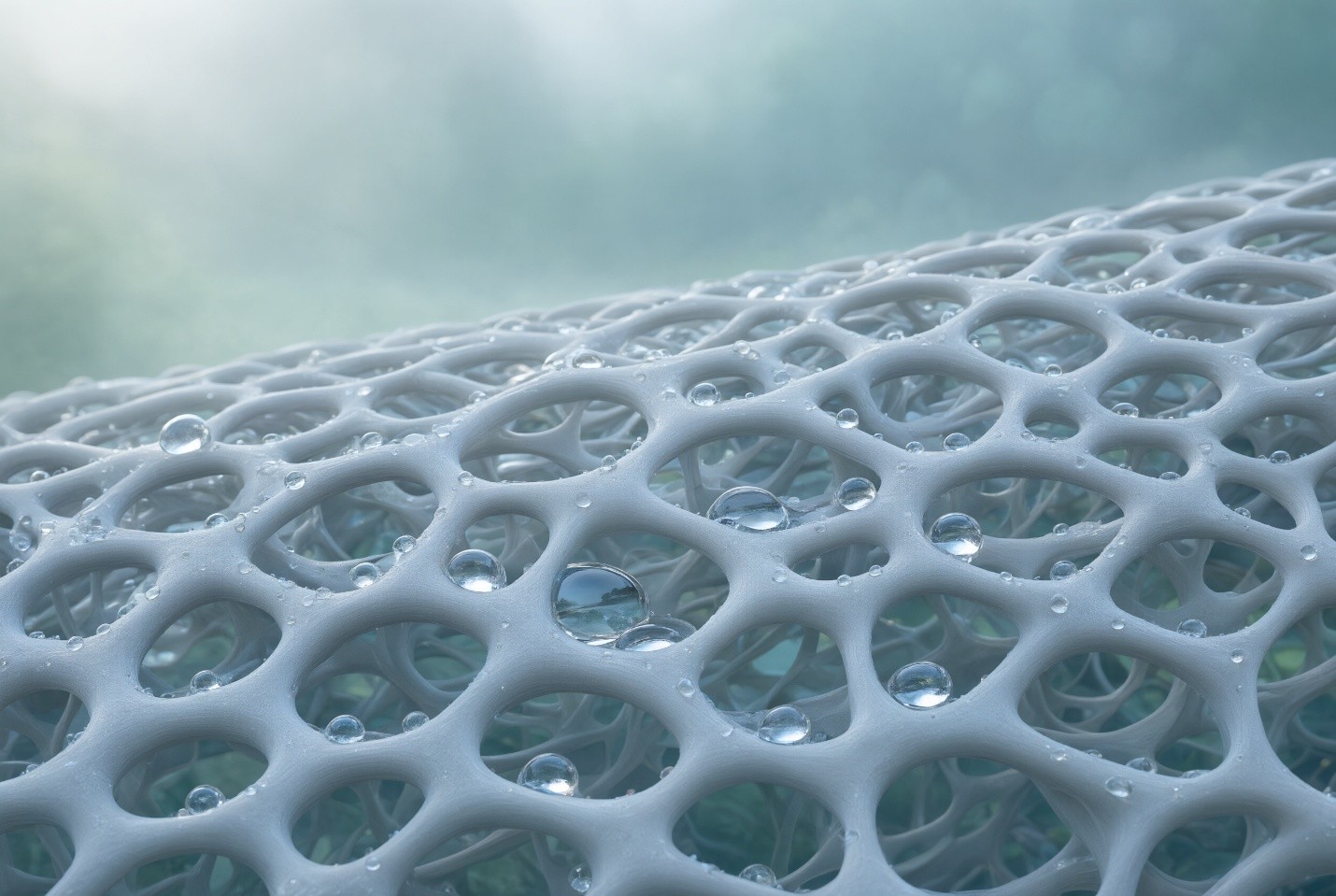
The shortage of drinking water and energy for cooling is an increasingly significant challenge. Researchers at the Laboratory for Sustainable Building Technologies at the Faculty of Mechanical Engineering, University of Ljubljana, and Shanghai Jiao Tong University have published a review article in the journal Advanced Materials (IF = 29.1), showing how 3D printing enables precise shaping of pores that affect heat and mass transfer, as well as optical properties. Such materials can help with water harvesting from the air and passive cooling of buildings.
Water scarcity in arid regions and increasing energy consumption for building cooling are challenges that will be important for future generations. Climate change can make traditional sources of drinking water less reliable due to droughts and heatwaves. Therefore, there is growing interest in passive technologies, such as sorption water harvesting from the air, solar-powered evaporative cooling and radiative cooling, which operate with minimal external energy input.
Until now, such porous materials have been produced using conventional chemical methods, which often create random and uneven internal structures. This limits their performance, as random pores cause bottlenecks when transferring heat and substances simultaneously.
Our research for the first time integrates additive manufacturing (3D printing) with precise porosity engineering, enabling the design of customised materials for specific heat and mass transfer needs and optical properties.
In this overview article, the authors present a unified framework for designing porous structures. 3D printing, especially the direct ink writing (DIW) method, enables digital control of pore size, shape and connectivity on multiple levels. This dramatically improves water uptake speed, reduces energy consumption in material regeneration and optimises passive building cooling. The study provides specific guidelines for transitioning from random materials to architecturally designed solutions.
“3D printing is not just an alternative manufacturing method, but a tool that enables us to treat pores as a primary design variable and create multifunctional materials to address the water-energy crisis,” emphasises Asst. Dejan Trajkovski, the study’s first author.
“With this study, we aimed to establish a unified framework for researching the effects of 3D-printed pore properties on optical properties and mass transfer properties in porous materials, and consequently to improve systems for atmospheric water harvesting from the air and passive radiative cooling,” adds the lead author, doc. dr. Primož Poredoš.
Future steps include using artificial intelligence for inverse design of optimal porous structures and integrating them into smart, multifunctional systems for sustainable water and energy management in real environments.