



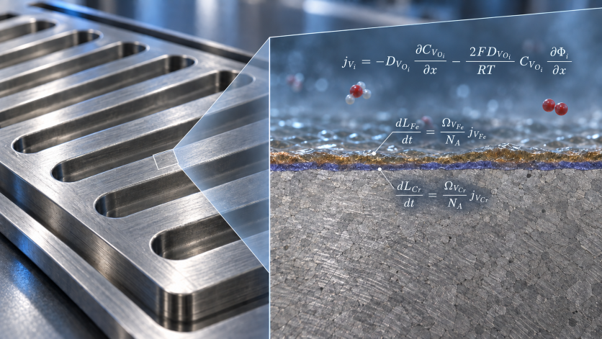
Bipolar plates are essential components of proton exchange membrane fuel cell (PEMFC) stacks. They distribute reactant gases, remove heat and electrically connect neighbouring cells. Because a stack contains many individual cells, bipolar plates strongly influence its efficiency, durability, weight and cost. They can be made from graphite, metals or composite materials. Stainless steels are particularly attractive because they combine good electrical conductivity and mechanical strength with low material cost and the possibility of manufacturing very thin plates using established industrial processes.
Their main drawback is corrosion in the acidic PEMFC environment. A nanometre-scale passive oxide film forms on the steel surface and protects the underlying material, but its growth can increase the electrical contact resistance and contribute to performance losses over time. On 316L stainless steel, this film typically consists of a chromium-rich inner layer and an iron-rich outer layer, whose evolution depends on local potential, oxygen concentration and water content. As these conditions vary across the cell, oxide growth is both spatially and temporally non-uniform.
Existing degradation models generally either treat the passive film as a single effective layer or are too computationally demanding for direct integration into spatially resolved PEMFC simulations. Researchers at the University of Ljubljana, Faculty of Mechanical Engineering, addressed this challenge by developing a physics-based model that separately resolves the growth of the two oxide layers while remaining computationally efficient. The work is presented in the paper “Spatially and temporally resolved stainless steel bipolar plate degradation model for PEMFCs”, published in the International Journal of Hydrogen Energy (IF = 9.2).
Within this research, the point defect model was extended from a local description of passive-film growth into a spatially and temporally resolved degradation model for stainless-steel bipolar plates. The model separately describes the evolution of the chromium-rich inner oxide and iron-rich outer oxide, including the transport and reactions of charged defects and metal species within both layers. Furthermore, it reproduced the measured oxide-thickness evolution with a root-mean-square error of below 0.1 nanometre. By coupling it with a multiscale PEMFC model, local variations in electric potential, oxygen concentration and water content across the cell are translated directly into predictions of oxide growth. Despite resolving these coupled performance and degradation related processes, the model runs approximately 11.9 times faster than real time. It can therefore be integrated into larger PEMFC simulations and may support degradation-aware simulation, comparison of materials and operating strategies, virtual sensing and digital-twin applications.
Illustrative image generated by AI.