



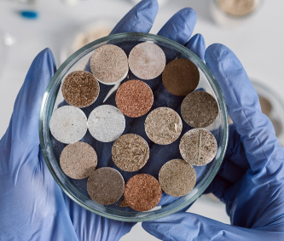
In a collaboration between the Division of Machine Elements at Luleå University of Technology, Sweden, and the Laboratory for Tribology and Interface Nanotechnology at the University of Ljubljana, researchers have produced fully bio-based polymer composites with promising friction and wear performance. The developed materials containing nanocellulose outperform the unreinforced plastic by nearly 90% in terms of wear resistance. The findings highlight the potential of these materials as longer lasting, more sustainable parts for machinery.
In moving machine parts, the used materials have to withstand repeated stress without excessive wear while ensuring efficient sliding. Nowadays, plastics are more commonly used for such purposes, however they are often sourced from fossil-based resources. Therefore, researchers are exploring sustainable alternatives using renewable feedstocks that also meet the engineering demands.
Polyamide 11, a plastic made almost entirely from renewable feedstocks, is already used in such applications, but little is known about how nanocellulose affects its friction and wear. The authors of this work, Lucas Kneissl, Roberts Joffe, Mitjan Kalin and Nazanin Emami, from Luleå University of Technology and the University of Ljubljana, combined this polymer with either 3% or 5% cellulose nanocrystals and characterized it alongside an unreinforced sample. The composites were manufactured using a liquid-assisted extrusion process, with the nanocellulose being introduced as water-based dispersion. Thermo-mechanical properties as well as the tribological performance in dry sliding against steel were evaluated.
Adding 3% nanocellulose reduced the measured wear coefficient by close to an order of magnitude. The 5% formulation produced the lowest friction coefficient, falling roughly 16% from the level of the unreinforced polymer. It also increased compressive strength by about 25%. The two formulations therefore delivered different benefits rather than one being best on every measure, therefore leaving room for future improvements.
The researchers also used Raman spectroscopy as a non-destructive technique to examine the morphology of transferred material in the wear tracks on the steel countersurfaces. Lucas Kneissl and his colleagues conclude that the material combination has potential for engineering parts used in various industries. Further tests regarding possible post-processing strategies to optimize the material composition and performance are planned for future work, as well as potentially broadening the tribological testing conditions to gain better understanding over the materials’ capabilities for a larger range of applications.
The full article, published in Results in Engineering, can be found under this link.