


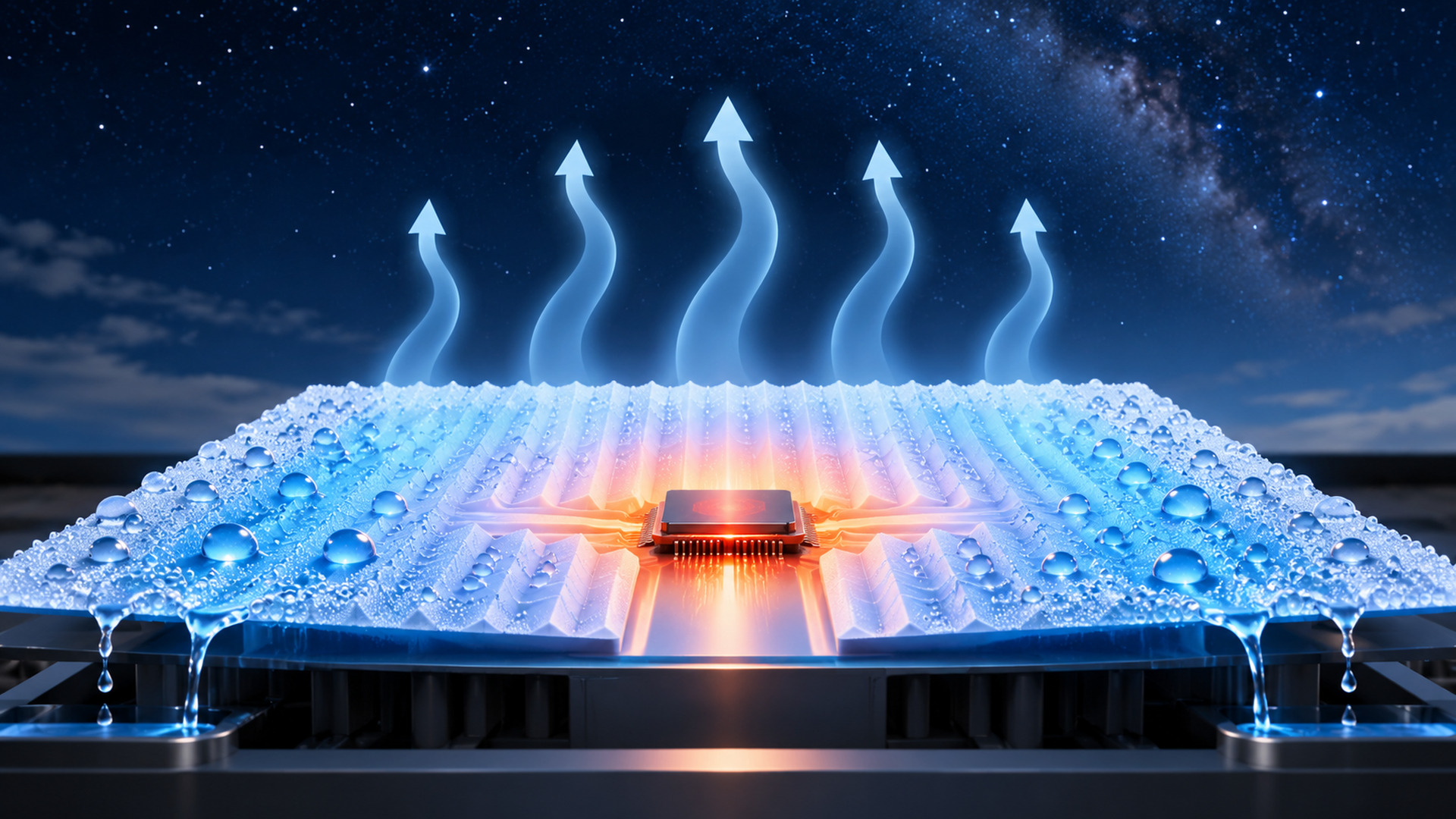
Cooling a hot device and collecting dew on the same surface sounds like a contradiction: one heats the surface, the other needs it cold. Dr Primož Poredoš and colleagues from the Laboratory for Sustainable Technologies in Buildings at the UL Faculty of Mechanical Engineering, with international partners, have shown that the right geometry makes both possible, powered only by the cold of space. The approach could passively cool outdoor electronics while harvesting water from the air.
Anyone who has wiped dew off a car windscreen on a clear morning has seen radiative cooling at work. At night, surfaces send heat into space as invisible infrared radiation, and space, at around −270 °C, is the ultimate heat sink. Below the dew point, water vapour from the air condenses on them as droplets.
Until now, this effect has been used either to cool devices or to harvest water. Combining the two seemed impossible: a device’s heat warms the surface, but dew only forms where it stays cold.
The team resolved this by connecting a small heat source to a much larger flat or pyramid-shaped emitter. Heat spreads towards the edges, leaving a warm, dry island around the source, while the outer regions stay cold enough to bead with dew.
Published in Energy & Environmental Science (IF=30.5), one of the world’s leading journals in energy and environmental research, the study combines optical measurements, modelling and outdoor experiments in Ljubljana and Shanghai. The heat source delivered about 1,000 watts per square metre, roughly the strength of the midday sun. Near it, temperatures stayed over 45 °C lower than on a reference surface, while the flat design still collected 9.3 grams of water per square metre per hour. At 1,500 watts, the reference approached 85 °C; the new designs stayed below 20 °C. Surprisingly, bigger pyramids are not necessarily better: in deep cavities, the walls radiate at each other instead of at the sky.
“Heat and dew are usually opposites. On our surface, they live side by side: the area around the hot device stays dry, while just a few centimetres away, water droplets grow out of thin air,” says Dr Primož Poredoš.
A global analysis mapped where both functions can work together, mainly in humid climates with clear nights. The approach could cool telecom cabinets and other outdoor electronics, buildings and vehicles without electricity. The next challenge is coatings that let droplets slide off even faster.
Primož Poredoš et al. From flat to structured: geometry-driven dual-mode radiative emitters for simultaneous hotspot cooling and water harvesting. Energy & Environmental Science, 2026. https://doi.org/10.1039/d6ee04674f
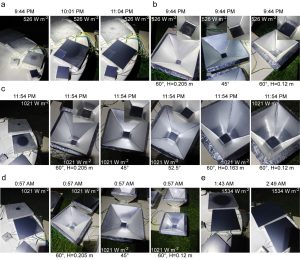
A night in Ljubljana, 10 September 2024. The grey sheen on the panels is dew; the dark circle in the middle is a dry island above the heat source. As the generated heat rises – from half to one and a half times the power of the midday sun – the dry spot grows. Smaller panels lose their dew entirely, while the largest one holds on to it even at the highest load. In the pyramids, the dry zone forms at the bottom, right above the heat source.