


Researchers at TINT, Faculty of Mechanical Engineering, University of Ljubljana, show a promising approach to reducing elastohydrodynamic (EHD) friction while preserving the lubricant film that protects moving surfaces.
Rayan Ajeeb, Marko Polajnar and Mitjan Kalin from the Laboratory for Tribology and Interface Nanotechnology (TINT) at the Faculty of Mechanical Engineering, University of Ljubljana, have shown that lubricant boundary slip, when it occurs in the appropriate contact region, can significantly reduce friction while preserving the protective lubricant film that separates moving surfaces in elastohydrodynamic lubrication. Their findings could support the development of more reliable and energy-efficient mechanical systems.
In many applications, operating in EHD lubrication regime including industrial machinery, automotive engines and wind turbines, moving surfaces are separated by a very thin lubricant film of only few hundred nanometres. This film prevents direct contact between surfaces, reduces wear and extends component lifetime. At the same time, reducing friction lowers energy losses and improves overall efficiency.
The researchers investigated boundary slip, a phenomenon in which a lubricant does not fully follow the motion of the solid surface and instead moves relative to it. Although slip can reduce friction, it may also reduce the thickness of the lubricant film. Using an advanced computational model based on Navier-stokes approach that combines lubricant flow and elastic surface deformation, the team identified where in the contact slip emerges and how its location influences friction and film thickness.
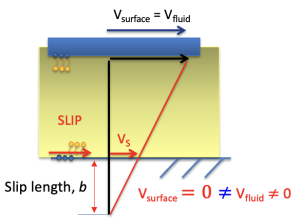
Their results show that the key factor is not whether slip occurs, but where it initiates. When slip is confined to the load-carrying region, the lubricant supply is preserved, and the protective film remains essentially unchanged. Under the conditions studied, friction was reduced by up to 48% without a reduction in film thickness.
“Our results show that the important question is not simply whether the lubricant slips, but where the slip begins. When slip occurs in the appropriate region, friction can be reduced while preserving the lubricant film that separates and protects the surfaces,” says first author Rayan Ajeeb.
The findings could support the development of advanced lubricants and surface coatings that could improve machine performance, reduce energy consumption and extend component lifetime. Future research will focus on temperature effects and practical lubricant-surface combinations that could enable predictable slip under real operating conditions.
The full research article is available online.