



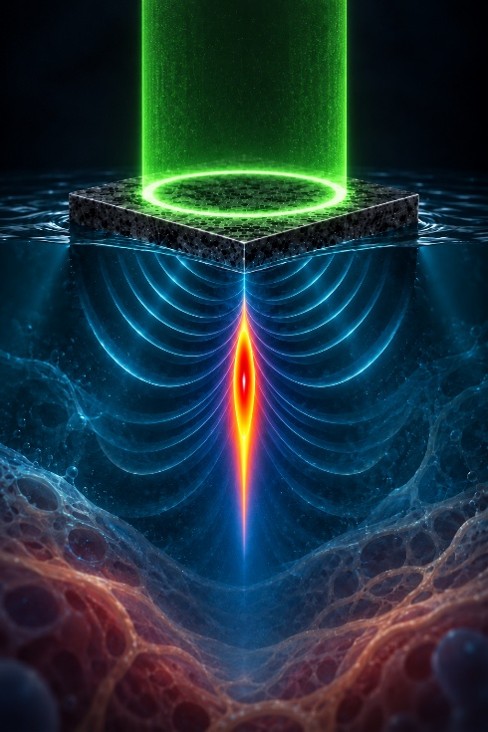
Researchers from the Laboratory for Laser Techniques (LASTEH) at the Faculty of Mechanical Engineering, University of Ljubljana, in collaboration with the Jožef Stefan Institute, have demonstrated a new approach for generating and controlling localized high-pressure acoustic fields using optical beam shaping.
Photoacoustic (PA) technology converts short laser pulses into acoustic waves through the thermoelastic effect. Conventionally, localized or focused pressure fields are generated by tailoring the geometry of the photoacoustic emitter. While effective, such approaches generally result in fixed acoustic geometries that cannot be readily adjusted once the device has been fabricated.
In the new approach, an axicon-based optical system transforms a Gaussian laser beam into a Bessel-like annular illumination pattern on a nanocomposite photoacoustic material. The acoustic waves generated around the illuminated ring constructively interfere along the central axis, producing a localized region of high acoustic pressure.
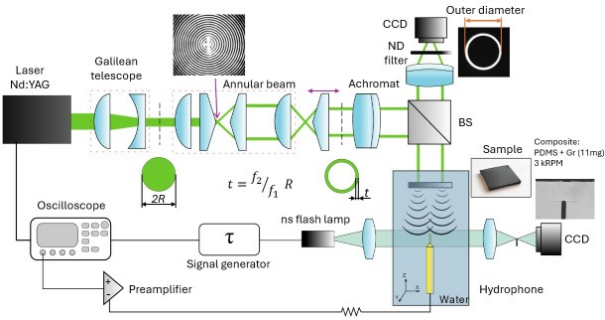
Figure: Schematic of the experimental setup: beam shaping from Gaussian to annular beam, characterization and monitoring of the PA wave with needle hydrophone and Schlieren imaging system.
A key advantage of the approach is that the position of the maximum pressure can be controlled optically, without modifying the geometry of the photoacoustic emitter. The researchers demonstrated control of the maximum-pressure position over more than one order of magnitude in depth, reaching positions up to 14 mm while maintaining nearly constant pressure amplitude and bandwidth.
The experimentally measured pressure reached approximately 2 MPa at an optical fluence of 20 mJ cm⁻² and up to 8 MPa at 80 mJ cm⁻². The −6 dB bandwidth remained around 22 MHz. The resulting pressure field exhibited a needle-like profile, with an extended high-pressure region of up to approximately 3 mm and lateral confinement of a few hundred micrometres.
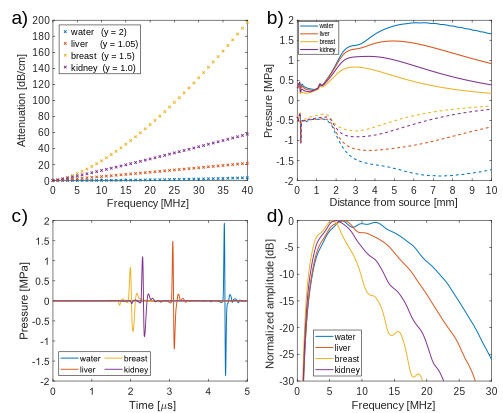
Figure: a) Acoustic absorption of each soft tissue as a function of frequency. b) Pressure profiles showing positive and negative pressure amplitudes along the axial direction. The solid line represents the positive peak pressure (P+), and dashed line represents the negative peak pressure (P-). c) Simulated pressure waveforms at the point of maximum pressure for each tissue, and d) the corresponding frequency spectra.
The pressure field was first experimentally characterized in water. The measurements were then used in a data-driven numerical approach based on nonlinear time-reversal reconstruction to determine the initial photoacoustic pressure distribution and predict acoustic wave propagation in soft tissue. The simulations demonstrated how tissue attenuation influences the pressure amplitude, bandwidth, position of maximum pressure, and extent of the high-pressure region. For the conditions investigated, the predicted mechanical index remained below commonly used diagnostic safety limits.
The results demonstrate that optical beam shaping can provide a flexible way to control the acoustic wavefront without mechanically modifying the photoacoustic source. This capability could be particularly useful for future ultrasound imaging approaches in which the depth of the region of interest needs to be adjusted dynamically. The work provides a basis for further development of tunable photoacoustic sources and their investigation for volumetric ultrasound imaging and other biomedical applications.
Published research
The results have been published in the open-access journal Photoacoustics (Elsevier), which currently has an Impact Factor of 6.9.
Authors: Laura Levstik, Matjaž Kos, Aleš Mrzel, Matija Jezeršek, Daniele Vella
Journal: Photoacoustics, Volume 51, 2026, Article 100879
DOI: 10.1016/j.pacs.2026.100879