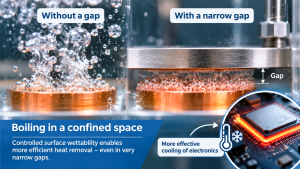
Researchers from the Laboratory for Thermal Technology (LTT) at the University of Ljubljana’s Faculty of Mechanical Engineering have shown that carefully pairing water-attracting and water-repelling surfaces can substantially improve boiling heat transfer in narrow gaps. Under selected test conditions, they achieved up to a 1,257% increase in the heat transfer coefficient and up to a 113% increase in critical heat flux. The findings could help advance compact cooling systems.
Modern electronics and power devices generate increasing amounts of heat, while the space available for cooling is shrinking. Boiling can remove heat efficiently by converting liquid into vapor. In narrow gaps, however, vapor may accumulate and restrict the supply of fresh liquid to the heated surface, reducing cooling performance.
Previous studies have often focused on gap size or the properties of an individual surface. Less was known about how the wettability of a heated surface interacts with that of the opposing confinement plate.
In a study published in International Journal of Heat and Mass Transfer, the team tested different combinations of laser-textured copper heating surfaces and stainless-steel confinement plates. They prepared superhydrophilic surfaces, on which water spreads readily, and superhydrophobic surfaces, which strongly repel water. Pool-boiling experiments were carried out with water at gaps ranging from 0.25 to 50 mm.
The most favorable arrangement combined a superhydrophilic heated surface with a superhydrophobic upper plate. Compared with an untextured reference arrangement, it increased critical heat flux (the threshold beyond which boiling cooling deteriorates sharply) by 113% at a gap of 1.25 mm and the heat transfer coefficient measured at critical heat flux by 1,257% at a gap of 0.25 mm. Reversing the positions of the water-attracting and water-repelling surfaces markedly reduced performance at the smallest gaps.
The results show that efficient cooling in confined spaces depends not only on the wettability of each surface but also on how the two surfaces are arranged. This insight could guide the design of future compact two-phase cooling systems.