



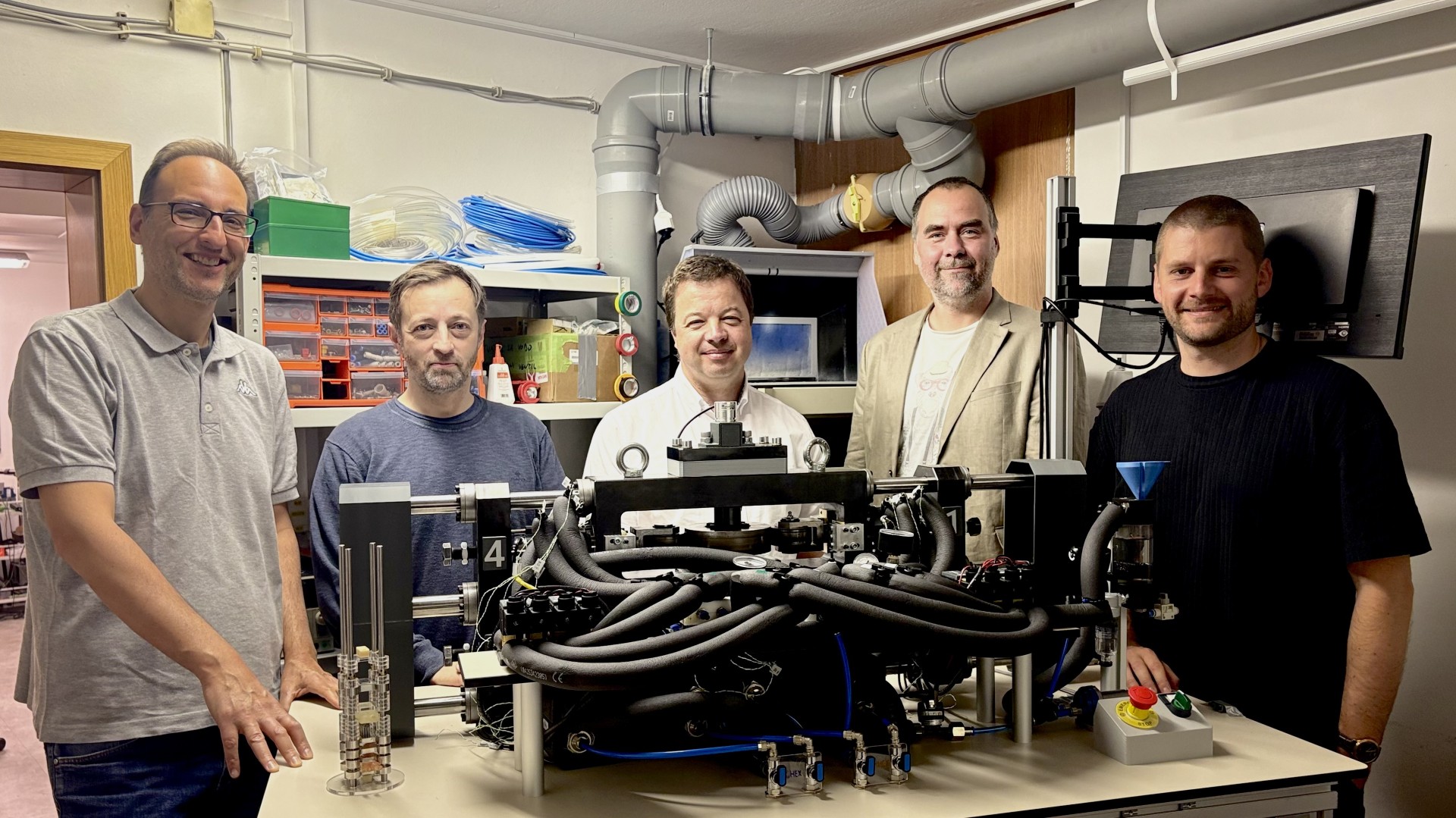
At the Faculty of Mechanical Engineering, University of Ljubljana, the elastocaloric research group, through a collaboration between the Laboratory for Nonlinear Mechanics (LANEM) and the Laboratory for Modelling Machine Elements and Structures (LAMEK), has developed a new drive system for elastocaloric cooling that significantly improves energy efficiency and represents an important step toward sustainable alternatives to conventional cooling technologies. The research results were published in the prestigious scientific journal Nature Communications.
The study was led by the elastocaloric research group of the Faculty of Mechanical Engineering UL under the supervision of Assist. Prof. Jaka Tušek, PhD. The researchers developed an innovative drive system for elastocaloric devices based on a constant-torque approach and direct mechanical work recovery. The system uses four phase-shifted elastocaloric elements and a specially designed cam-disc mechanism, theoretically enabling a constant load on the electric motor during operation.
Elastocaloric cooling is considered one of the most promising future cooling technologies because it enables refrigeration without environmentally harmful refrigerants and offers significantly higher energy efficiency than today’s vapor-compression systems. However, one of the key challenges in advancing the technology remains the development of efficient and compact mechanical drive systems capable of generating large forces while maintaining low energy consumption.
In the published study, researchers from the Faculty of Mechanical Engineering UL experimentally demonstrated that their system achieves nearly constant torque on the drive shaft and up to approximately 70% efficiency in mechanical work recovery at forces of up to 40 kN. Numerical simulations further suggest that, with additional optimization, the efficiency could be increased to as much as 88%.
“The key advantage of the solution is that it enables an almost uniform mechanical loading of the driving system and efficient energy recovery during operation. This significantly reduces the required maximum input power, and enables further optimisation of the driving system, which is one of the main prerequisites for the future implementation of elastocaloric systems in real-world devices,” emphasized the first author of the study, Assist. Prof. Andrej Žerovnik, PhD.
The head of the research group, Assist. Prof. Jaka Tušek, PhD, added:“The developed solution represents an important breakthrough in elastocaloric technology, as it directly addresses one of the key limiting factors in the transition from laboratory demonstrators to practical cooling and heating systems. We are particularly pleased that a patent application has also been filed for the developed concept, confirming its strong application and innovation potential.”
The new approach enables a more compact, mechanically balanced, and energy-efficient device design, bringing elastocaloric technology significantly closer to practical application and commercialization.
The research paper entitled Efficient Elastocaloric Drive System Enabled by Constant-Torque and Work-Recovery Design was conducted in collaboration between researchers Assist. Prof. Andrej Žerovnik, PhD, Stefan Dall’Olio, PhD, Assist. Prof. Simon Krašna, PhD, Žiga Ahčin, PhD, and Assist. Prof. Jaka Tušek, PhD. The research was supported by two European Research Council (ERC) projects – Strating Grant and Proof-of-the-concept Grant – and the Slovenian Research and Innovation Agency (ARIS).
Figure 1: Prototype of an innovative drive system for elastocaloric cooling based on constant torque and mechanical work recovery.
Figure 2: Elastocaloric group, Faculty of Mechanical Engineering, University of Ljubljana (from left to right): Assoc. Prof. Simon Krašna, PhD; Stefano Dall’Oli, PhD; Assoc. Prof. Andrej Žerovnik, PhD; Assoc. Prof. Jaka Tušek, PhD; and Žiga Ahčin, PhD.