Mechanical stress can either accelerate or inhibit electrochemical processes in lithium-ion batteries – depending on the electrode materials and the battery’s state of charge. Researchers at the Laboratory for Internal Combustion Engines and Electromobility (LICeM) at the Faculty of Mechanical Engineering, University of Ljubljana, demonstrated this using a physics-based model, explaining previously conflicting experimental results. These findings form the basis for more accurate diagnostic tools that will enable safer use and longer service life of batteries, contributing to the advancement of e-mobility.
During operation, lithium-ion batteries are subject to cyclic volume changes: particles of electrode materials expand and contract during charging and discharging, while electrochemical cells are subjected to additional compression when integrated into battery cells or modules. Mechanical interactions at the particle and electrode scales determine a mechanical stress field that directly influences the electrochemical processes within the cell and, consequently, its performance.
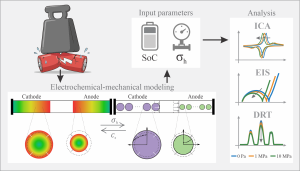
Such changes in battery performance can be detected using non-invasive diagnostic methods, such as incremental capacity analysis (ICA) and electrochemical impedance spectroscopy (EIS), the atter of which can be further analyzed using the distribution of relaxation times (DRT). Experimental studies have shown that mechanical loads affect the results of these methods; however, the literature reports conflicting trends, and the underlying physical mechanisms have not been consistently explained.
In their article »Impact of mechanical stress on electrochemical performance of the lithium-ion battery«, published in the Journal of Energy Storage (IF = 10.7), LICeM researchers presented the first numerical study of the effect of mechanical stress on the ICA, EIS, and DRT of a lithium-ion cell. They extended an established electrochemical model with a fully coupled multiscale mechanical model that accounts for stresses both within individual electrode particles and between them. Using this model, they simulated diagnostic measurements under various mechanical loads to investigate how stress affects electrochemical processes.
The simulations showed that mechanical stress alters the chemical potential of lithium in the electrodes, causing the peaks of the ICA curves to shift toward lower voltages. The effect on impedance, however, depends on the battery’s state of charge: impedance decreases at a low state of charge and increases at a high state of charge. To explain both phenomena, the researchers proposed a dominant electrode theory and clarified that the effect of mechanical stress on the entire cell is determined by the electrode with the stronger electrochemical-mechanical response, which depends on the mechanical properties of the active material and the slope of the open-circuit potential curve. Since the direction of these changes can be predicted based on the materials’ properties, these findings are directly applicable to the development of diagnostic and prognostic tools, such as those used in battery management systems for electric vehicles.