



Periodontal and peri-implant diseases are among the most common causes of tooth loss, as bacterial biofilms persistently accumulate in deep and narrow pockets around teeth. Traditional cleaning methods often fail to reach these areas safely and effectively. Despite not being a novel approach, the use of the Er:YAG laser is being further investigated by researchers at the University of Ljubljana for enhanced cleaning applications.
A research team from the Faculty of Mechanical Engineering, the Biotechnical Faculty, the Medical Faculty, and the company Fotona has demonstrated that surface roughness is a key factor in the success of Er:YAG laser cleaning. In their study, they developed a realistic, transparent pocket model that mimics soft tissues and implants, enabling high-speed visualization of fluid dynamics during laser cleaning.
The method is based on optodynamic phenomena, in which short laser pulses in water generate vapor bubbles. These bubbles expand and collapse rapidly, producing pressure waves that trigger cavitation even several millimeters away from the fiber tip. Cavitation is a process in which small vapor bubbles form and collapse due to rapid pressure changes in the liquid. As they collapse, they release energy and create strong microflows in the fluid. These processes significantly enhance the efficiency of removing impurities from surfaces by increasing the mechanical action of laser cleaning.
Unlike direct laser ablation—where the laser removes material through direct heating—this approach is independent of the material type and therefore safe for delicate surfaces such as dental implants.
Surprisingly, the researchers also observed effective bacterial removal in areas where cavitation bubbles were not visible. A detailed analysis revealed that rough surfaces allow deeper water penetration and promote the formation of secondary cavitation, thereby increasing cleaning efficiency even beyond the immediate reach of the laser fiber.
“Our research clearly shows that surface structure plays a crucial role in enabling non-invasive cleaning. These results will contribute to safer and more effective treatment of periodontal diseases and peri-implantitis,” says Prof. Matija Jezeršek, senior author of the study.
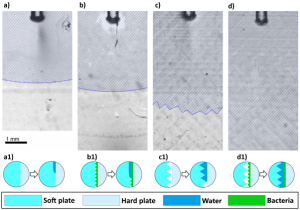
Visualization of the effect of surface roughness and bacterial presence on water penetration and cleaning efficiency in a narrow dental pocket model. The fiber tip is shown at the top, and the blue shading indicates the area where the bacterial film was at least partially removed.
The study was published in the journal Ultrasonics Sonochemistry.
Acknowledgement
This research was supported by the Slovenian Research Agency (ARIS) under research project L7-3186 and national programs P4-0116 and P2-0392, and was also carried out within the framework of the GREENTECH project: Hybrid Technologies of Factories of the Future for the Green Transition, co-financed by the European Union – NextGenerationEU.