



Researchers at the Laboratory for Dynamics of Machines and Structures (LADISK) have shown that a single infrared camera can reveal the complete stress state over the whole surface of a vibrating structure, with no sensors attached to it. Designers can use this to find where a vibrating part will crack and how soon, and so build lighter parts that still survive their service life.
Structures that vibrate, from aircraft panels to car brackets, rarely crack where the load is largest. They crack where the stresses acting in several directions combine most unfavourably. Predicting such a failure calls for the complete stress state at every point of the surface, and measuring that over a whole surface has so far not been possible.
Today engineers either compute the stresses from a numerical model that has to be validated first, or measure them with strain gauges glued to a few selected points. The gauges add mass and wiring, they degrade under prolonged vibration, and a handful of them can easily miss the critical spot.
The new method removes both limitations and recovers all the surface stress components over the entire structure from a contactless camera measurement.
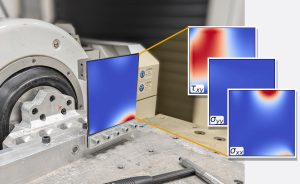
Photo 1: The measured stress field, the sum of the normal stresses, laid onto the aluminium plate clamped on the shaker.
An infrared camera detects temperature changes of a few thousandths of a degree which, through the thermoelastic effect, carry information about the sum of the normal stresses only. In the first step of the method, the camera data are merged with a deliberately simplified numerical model into hybrid stress-mode shapes that hold all the stress components. In the second step, the camera response recorded during random base excitation is projected onto these shapes and expanded into the full stress spectrum. The method was validated on a clamped aluminium plate, where a grid of 34 x 34 measurement points gives what 1156 strain-gauge rosettes would deliver (published in Mechanical Systems and Signal Processing, IF=10.2).
The next step is to feed these stress fields straight into fatigue models, so that the remaining life of a vibrating structure can be estimated in near real time from a camera recording alone.
Article: Full-Field Full-Stress-Tensor Identification of Base-Excited Structures, Mechanical Systems and Signal Processing (IF=10.2), https://www.sciencedirect.com/science/article/pii/S088832702600943X
Authors: Jaša Šonc, Klemen Zaletelj, Janko Slavič, Laboratory for Dynamics of Machines and Structures (LADISK), UL Faculty of Mechanical Engineering