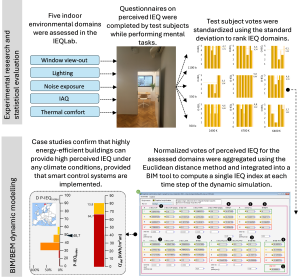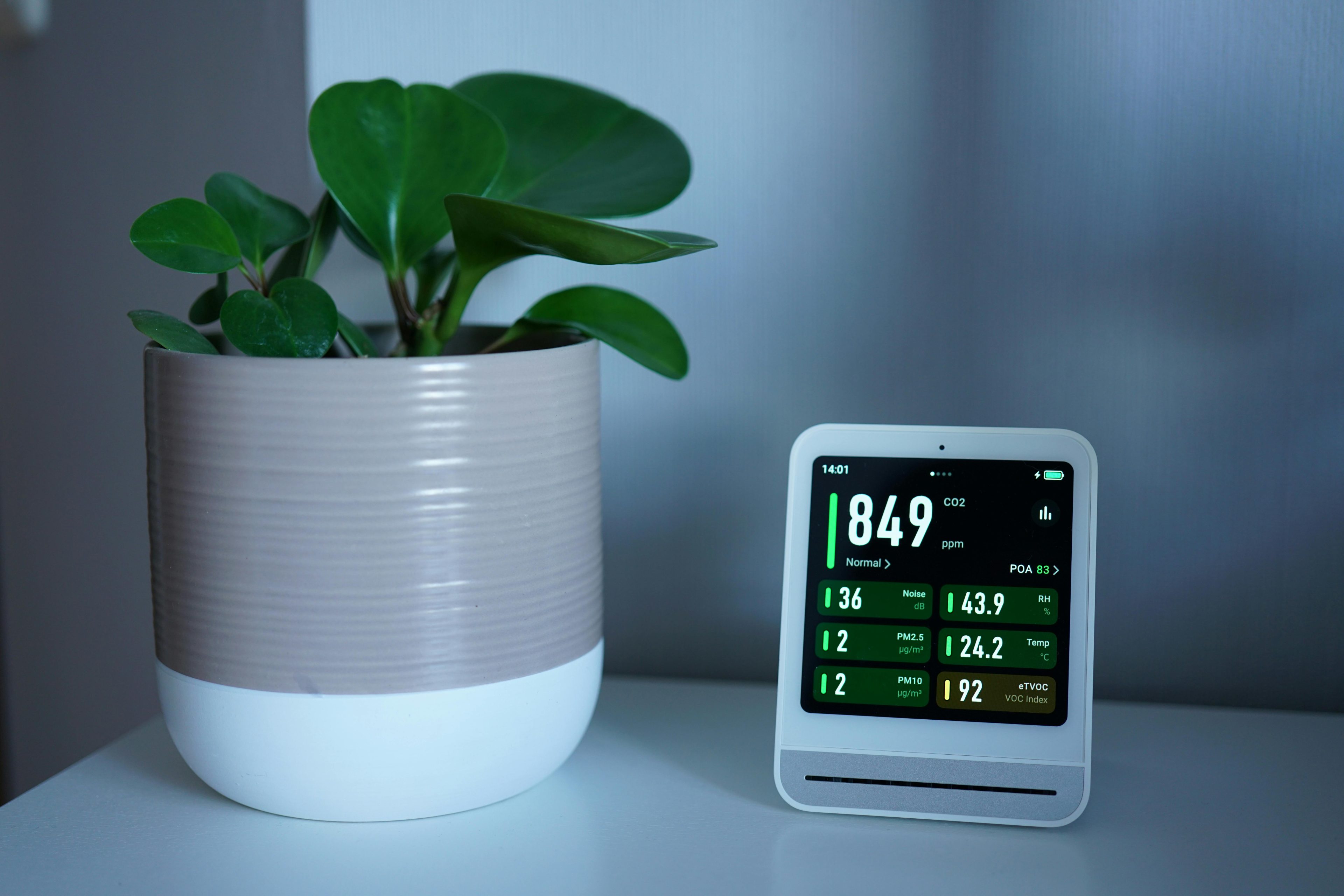
Researchers from the Laboratory for Environmental Technologies in Buildings (LOTZ) published a study in the journal Results in Engineering (Impact Factor 7.9) investigating the influence of physical variables across five indoor environmental domains on perceived indoor environmental quality. Based on these findings, they developed an integrated predictive model and implemented it, as the first interoperable module, within a BIM tool. The results demonstrate that the proposed integrated index of perceived indoor environmental quality is more appropriate than the currently established standardized indoor environmental quality classes for individual environmental domains.
Sustainable buildings must achieve high energy efficiency while simultaneously providing occupants with optimal indoor environmental conditions for living and working. Achieving these complex objectives requires that building functionality be evaluated by designers already during the design phase. This article presents the development of a comprehensive model for assessing perceived indoor environmental quality (IEQ), which integrates five indoor environmental domains. The model is based on weights determined from the standard deviation of experimental results and combines the influence of individual domains into an integral numerical score using the Euclidean distance. The model is linked to a dynamic building simulation and is used as part of the Building Information Modelling (BIM) process. It has been developed as an interoperable module for other designers, which represents a novelty in BIM applications.
The study includes: i) Models for classifying perceived IEQ in five assessment domains, based on participant responses while performing cognitive tasks under different controlled states of physical variables, each corresponding to standardized values (IEQ quality classes I–IV); ii) Definition of domain weighting factors using an entropy-based method, and the development of an algorithm for calculating an integrated perceived indoor environmental quality index, named P IEQINDEX; iii) Integration of the P IEQINDEX algorithm into a BIM tool, implemented as a macro using visual programming; iv) A case study with dynamic building simulation, demonstrating a positive correlation between P IEQINDEX, smart control algorithms, and energy efficiency measures.
This approach enables building designers to make informed decisions leading to the design of net-zero energy buildings with maximum perceived indoor environmental quality throughout the building’s lifecycle. The perceived indoor environmental quality index establishes a foundation for replacing the current qualitative assessment of indoor environmental quality using standardized classes with a quantitative evaluation of IEQ.