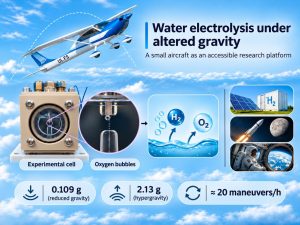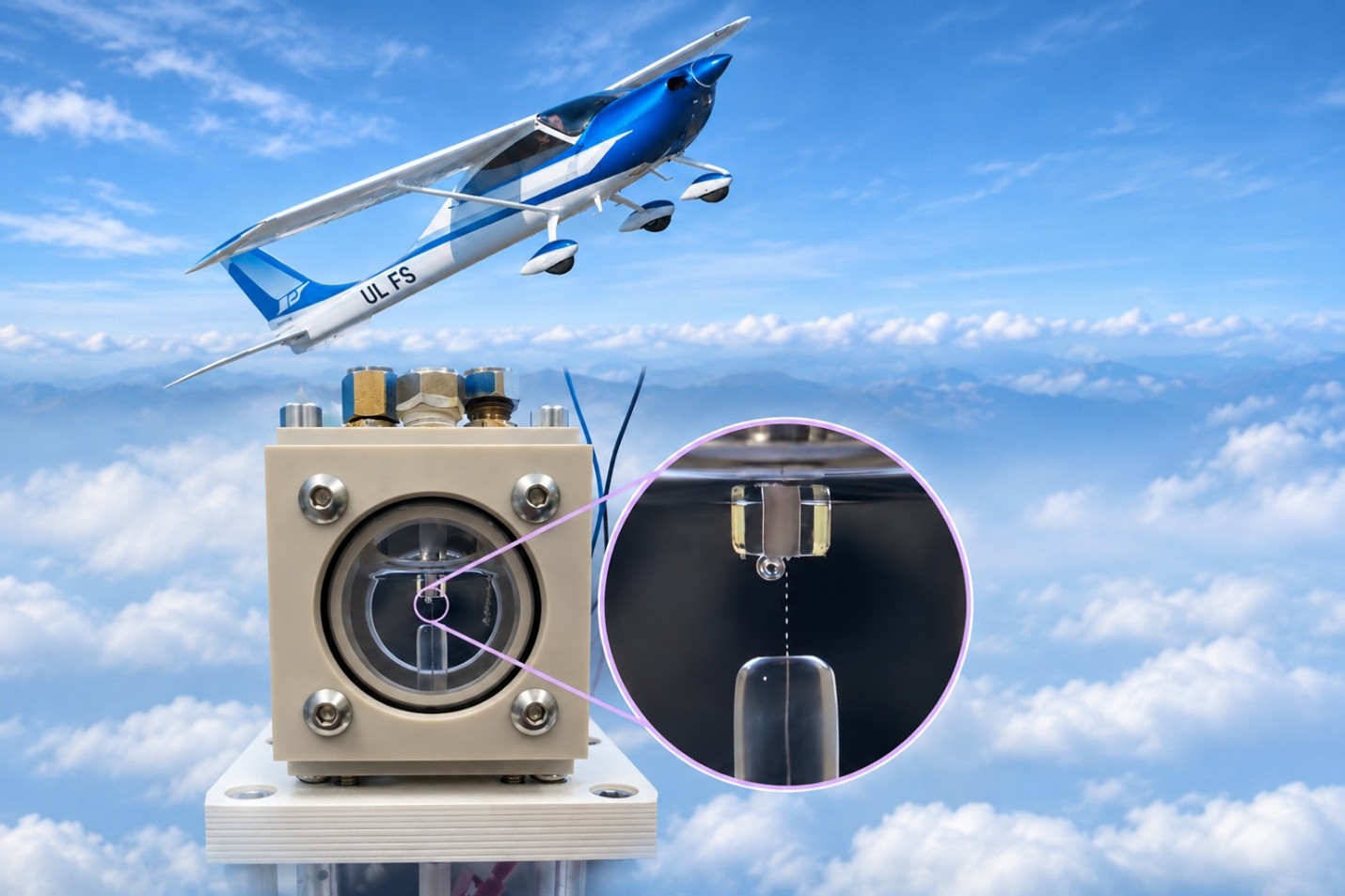
Researchers from the Laboratory for Thermal Technology (LTT) at the University of Ljubljana Faculty of Mechanical Engineering have demonstrated that a small general aviation aircraft can serve as an accessible and low-cost platform for investigating water electrolysis under altered gravity. During parabolic flight maneuvers, they achieved gravity levels below lunar gravity, opening new opportunities for preliminary testing of technologies for future space missions.
Water electrolysis enables the production of hydrogen and oxygen, which are essential for energy conversion, propellant production, and astronaut life support. Under reduced gravity, weaker buoyancy makes it more difficult to remove gas bubbles from electrode surfaces, potentially affecting the performance of electrolysis systems.
Altered-gravity research is typically conducted using specialized aircraft, drop towers, sounding rockets, or the International Space Station. Access to these platforms often involves substantial costs and logistical challenges. The researchers therefore investigated whether a small general aviation aircraft could provide an alternative platform for preliminary experiments.
In a study published in the scientific journal Results in Engineering (IF = 9.4), the researchers characterized the achieved gravity conditions and performed electrochemical measurements and high-speed imaging of oxygen bubbles on non-textured and laser-textured platinum microelectrodes.
During parabolic maneuvers, average acceleration levels of 0.109 g and 2.13 g were achieved under reduced-gravity and hypergravity conditions, respectively. These phases lasted an average of 2.15 and 4.71 seconds, with approximately 20 maneuvers possible per hour of flight.
The results showed that reduced gravity was generally associated with lower current densities, while higher values were observed under hypergravity, consistent with the observed differences in oxygen bubble detachment. Higher current densities were also measured on the laser-textured electrode, although further investigations are required to independently establish the effect of surface texturing.
Rather than replacing established research facilities, the proposed approach complements them by enabling faster and more affordable preliminary testing of experimental solutions and technologies intended for future space missions.