The research team of the Laboratory for Experimental Mechanics (LEM) at the Faculty of Mechanical Engineering, in collaboration with the Surface Technology Group of the Jožef Stefan Institute (IJS), conducted an experimental study on carbon nanocomposites, addressing the significance of carbon nanotube (CNT) networks on the thermo-mechanical stability and electrical conductivity of flexible nanocomposites. The results of the research were published in a reputable materials science journal, Materials & Design (IF = 7.9).
The presented study is strongly connected to current and future-emerging flexible sensor technologies, which are key components in many fields, ranging from the automotive and aerospace industries to medicine. Considering the wide range of applications, these materials are exposed to various environmental and loading conditions, and must exhibit exceptional functional properties, which, in addition to electrical conductivity (related to sensitivity), also include thermo-mechanical stability. The functionality of such materials primarily depends on the established CNT network, i.e., the interconnections between structure and properties, which was the main focus of the study.
Accordingly, the primary objective of the study was to establish a clear link between the main building blocks of the network, its formation/configuration, and the resulting impact on the electrical properties and thermo-mechanical behavior of flexible nanocomposites composed of multi-walled carbon nanotubes (MWCNT) and thermoplastic polyurethane (TPU).
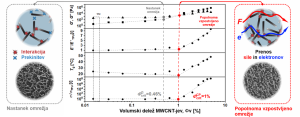
Using advanced experimental experimental techniques (plasma etching and electron microscopy, rheological thermo-mechanical analysis and electrcal analysis, etc.), it was shown that the network is composed of MWCNT bundles (the basic building block), rigid rod-like (Brownian) entities that, due to the amorphous nature of the elastomeric matrix, randomly geometrically entangle. It was shown that the emergence of functionality (electrical conductivity, thermo-mechanical stability, etc.) does not depend solely on the formation of a
CNT network at 0.46 vol% MWCNT, but occurs when the network is fully established at 1 vol% MWCNT. At this point, the electrical conductivity improves by 8 orders of magnitude (from 10⁻¹¹ to 10⁻³ S/m), and the thermo-mechanical stability, characterised by the glass transition temperature, increases by 30°C (from 20 to 50°C).
These key findings enable not only the production of carbon nanocomposites with relative flexibility and remarkable conductivity but are also of critical importance for flexible sensor technology.
Graphical abstract: