



Research projects are (co)financed by the Slovenian Research and Innovation Agency

- Member of the University of Ljubljana: Faculty of Mechanical Engineering
- Project code: Z7-60185
- Science: Engineering sciences and technologies
- SICRIS: Sustainable Environmental Solutions: Spatial Domain as the Future of Noise Monitoring
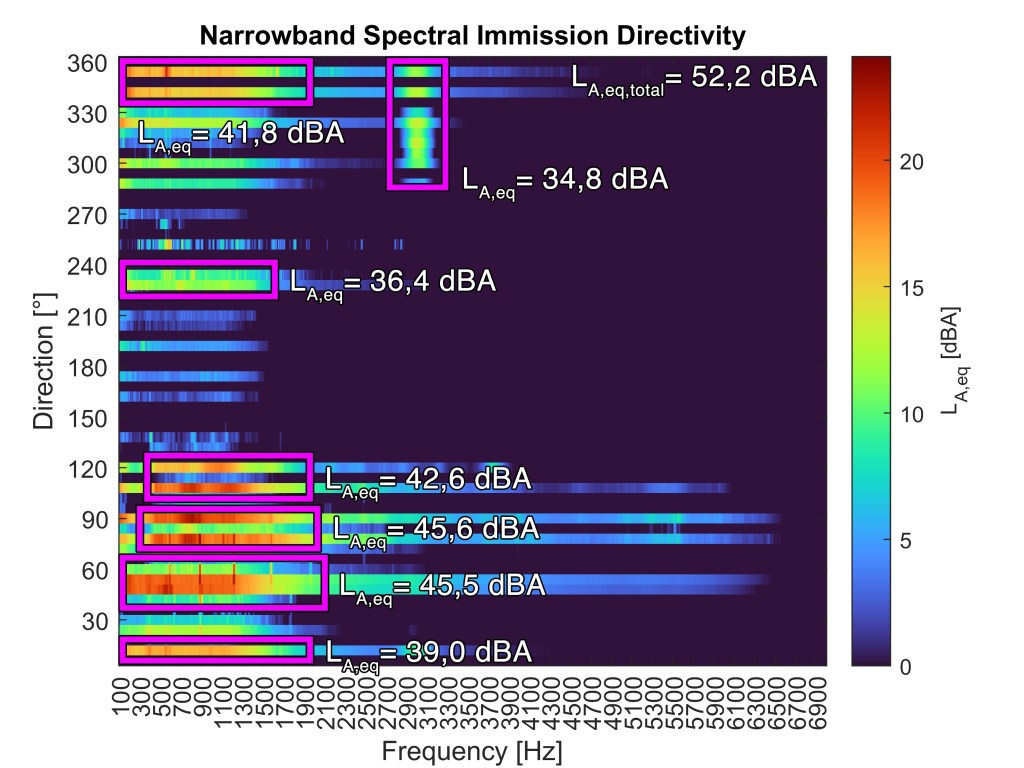
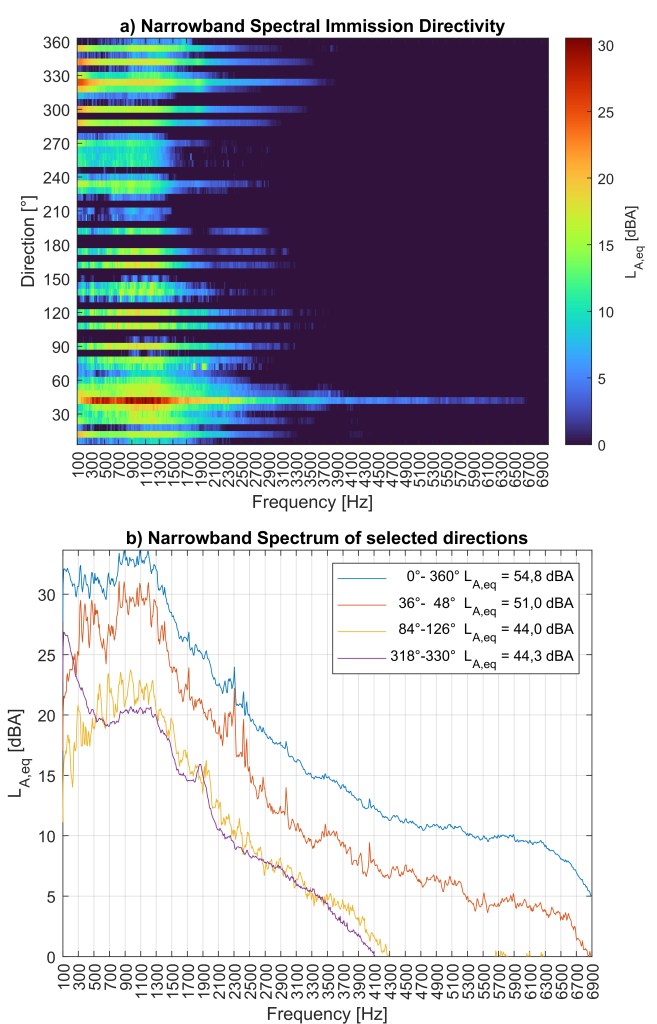
For the first time, narrowband spectral immission directivity (SID) has been tested outside the lab and in real-world conditions. Over the course of three separate 24-hour measurement campaigns at different locations, we captured and analyzed environmental noise using this new approach.
The results (see figures below) show spectra for specific directions, calculated directly from the recorded data. What makes this exciting is how SID combines time, frequency, and direction into a single picture of the sound environment.

Milestone M1 (100%): Development of an advanced algorithm and its implementation in a prototype measurement device.
Milestone M2 (100%): Investigation of the impact of incorporating the spatial domain and the features derived from it for the classification and identification of main environmental noise sources.
Milestone M3 (10%): Installation of a permanent wireless measurement station
Milestone M4 (55%): Successful completion of the project.
An advanced algorithm for measuring Spectral Immission Directivity (SID) has been developed, integrating temporal, spectral, and spatial characteristics of noise, and has been implemented in a prototype measurement system. The system enables real-time multichannel signal acquisition and processing, as well as the generation of spatial-spectral representations of noise. Experimental measurements in real environments have confirmed the system’s capability to determine the dominant direction of sound arrival and to identify characteristic frequency components.
The research has shown that incorporating the spatial domain enables the differentiation of noise sources based on direction and frequency content, thereby providing a foundation for further identification and classification of individual sources. Spatial-spectral analysis reduces data volume and the complexity of automatic classification, while opening up new possibilities for advanced environmental noise monitoring methods.
Hypothesis 1 – 100%: A small microphone array and an advanced algorithm enable the determination of the direction of sound arrival for individual frequencies in real time. The hypothesis is confirmed.
Hypothesis 2 – 50%: The prototype equipment enables the inclusion of the spatial domain and the preparation of a system for calculating the spatial distribution of noise. For final evaluation, the inclusion of psychoacoustic features and additional measurements is required.
Hypothesis 3 – 25%: The hardware is prepared for the implementation of classification algorithms for distinguishing between noise sources. For final evaluation, measurements with implemented algorithms are required.