




Cold starts of hydrogen fuel cell vehicles do not only lead to lower efficiency and reduced performance, but also have a significant impact on fuel cell lifetime. Researchers from the Laboratory for Internal Combustion Engines and Electromobility (LICeM) developed and validated a simulation model showing that, at low temperatures, the cumulative catalyst degradation during a cold start, quantified as the loss of electrochemically active surface area (ECSA), can be up to 100 times faster than at higher temperatures.
PEM fuel cells enable zero-emission mobility, yet their lifetime is limited by the degradation of key components, including the catalyst. During cold starts of PEM fuel cells at sub-zero ambient temperatures, the fuel cell must be rapidly heated to an appropriate operating temperature. This is most commonly achieved through accelerated warm-up, where efficiency is intentionally reduced to increase heat generation, but such strategies simultaneously create non-uniform conditions within the cell. In addition, water can freeze, restricting reactant access to reaction sites and causing locally high potentials and heterogeneous loading of the fuel cell. The result is locally accelerated catalyst degradation.
In the article »Predicting the impact of ambient temperature on PEM fuel cell cold start-up catalyst degradation with a multi-domain and multi-scale modeling framework«, published in the renown journal Energy Conversion and Management (IF = 10.9), the authors present an advanced simulation approach based on multi-domain and multi-scale modeling. The simulation framework links a system-level electrochemical model with a mechanistic catalyst degradation model that includes platinum dissolution and carbon support corrosion. Using a model validated with data from a Toyota Mirai over temperatures from −18 °C to 35 °C, it was shown that ice formation induces transient heterogeneities within the cell, local hydrogen starvation, and high potentials, leading to catalyst degradation rates approximately two orders of magnitude higher than during starts at higher temperatures. Within the first 200 seconds of a cold start, the cumulative ECSA loss at sub-zero temperatures is about 100 times faster than during starts at higher temperatures.
The authors conclude that ambient temperature during cold starts and the selected start-up control strategy significantly affect catalyst lifetime, and that the model can serve as a virtual test platform for optimizing start-up protocols in terms of both performance and durability. In the future, such a model could become part of digital twins that virtually predict degradation rates and enable advanced, model-based control of fuel cell systems.
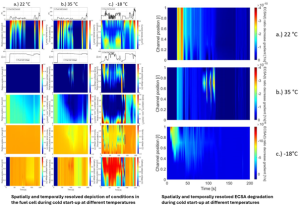
Figure 1 Summary of key contributions