



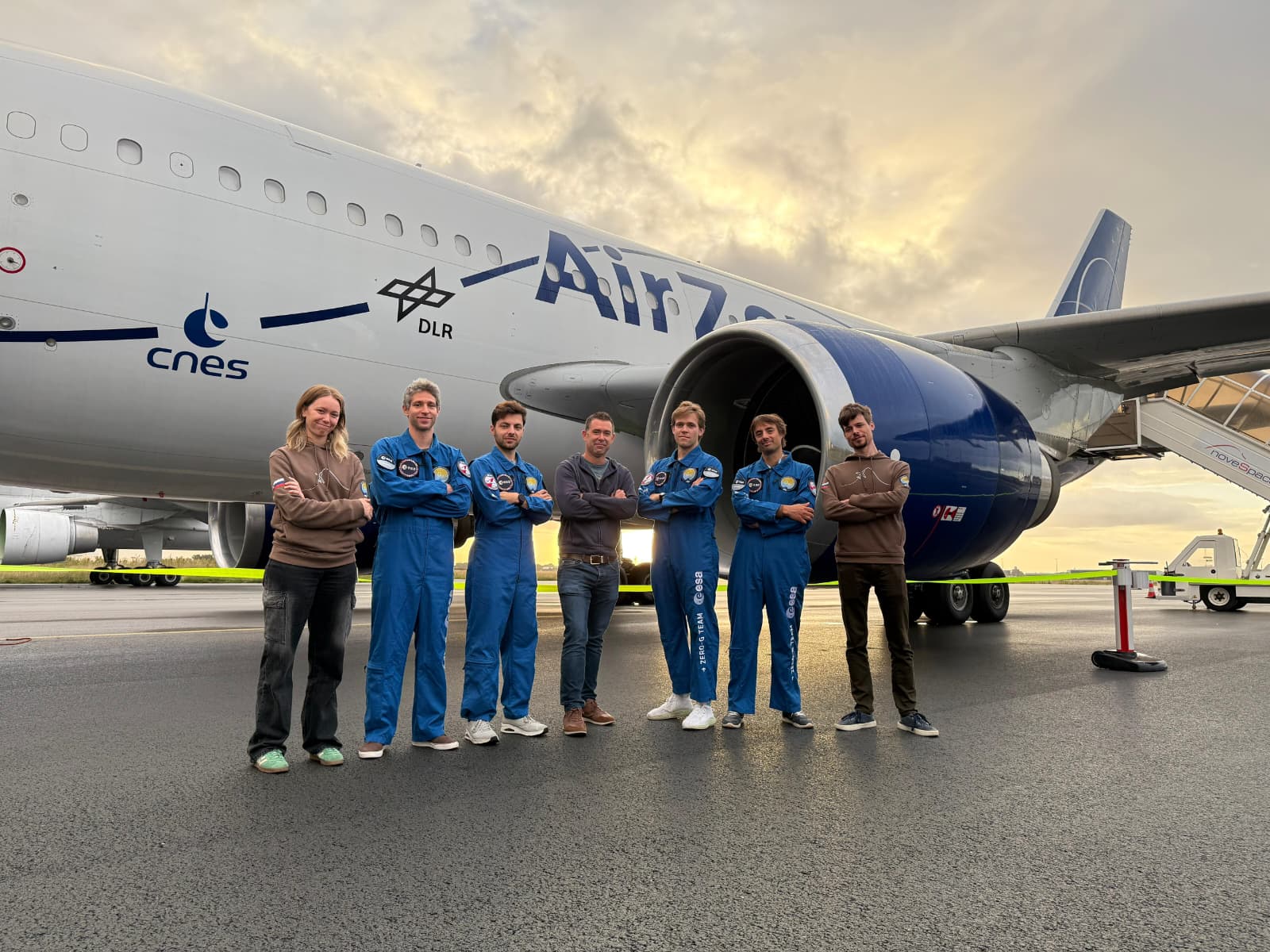
Mayonnaise, cosmetic creams and many pharmaceuticals all have one thing in common—they are emulsions, mixtures of two immiscible liquids. On Earth, gravity plays an important role in their formation. But what happens when gravity is removed? Researchers from the University of Ljubljana, Faculty of Mechanical Engineering, have, for the first time, directly visualized the process of ultrasonic emulsification under microgravity, revealing that the absence of gravity significantly affects both the rate of emulsion formation and the quality of the resulting emulsion.
Emulsions are ubiquitous in industries ranging from food production and cosmetics to pharmaceuticals and medicine. Their quality largely depends on how efficiently one liquid can be dispersed into another. Ultrasonic emulsification is among the most effective techniques, relying on acoustic cavitation—the growth and violent collapse of bubbles generated by high-intensity ultrasound—to break larger droplets into much smaller ones.
Under terrestrial conditions, gravity maintains a stable and well-defined interface between the oil and water phases, enabling controlled interaction with the cavitation zone created at the tip of the ultrasonic probe. Until now, however, this process had never been investigated under microgravity conditions.
A student research team, supervised by Professor Matevž Dular, conducted the CAVE 0g experiment as part of the 87th European Space Agency (ESA) Parabolic Flight Campaign. For the first time, they directly visualized ultrasonic emulsification in microgravity. Using a Photron SA-Z high-speed camera operating at 50,400 frames per second, the researchers recorded emulsion formation for different oil-to-water ratios and compared the results with reference experiments performed under normal gravity.
The findings have been published in the journal Ultrasonics Sonochemistry (Impact Factor: 9.7): https://www.sciencedirect.com/science/article/pii/S1350417726001604

The study demonstrates that, in the absence of gravity, capillary forces become the dominant mechanism governing the shape and position of the liquid–liquid interface. As a result, the interaction between the cavitation zone and the interface becomes less predictable, leading to slower and less efficient emulsification.
“We found that the position of the oil–water interface is a key parameter governing emulsification efficiency. In microgravity, however, this interface can no longer be controlled in the same way as under Earth’s gravity,” explains Jakob Mali, the paper’s first author.
These findings provide a foundation for the development of active strategies for controlling the liquid–liquid interface in microgravity, a key prerequisite for the efficient preparation of emulsions during long-duration space missions.