



The average power of industrial ultrashort-pulse lasers continues to increase, yet the maximum specific removal rate is achieved at relatively low laser fluences. One way to make better use of the growing laser power available is to distribute the energy of a single pulse across multiple sub-pulses delivered in a MHz burst. Researchers from the Laboratory for Laser Techniques at the Faculty of Mechanical Engineering, University of Ljubljana, in collaboration with the Laser Center HM at Munich University of Applied Sciences, have developed a model describing how residual heat accumulation affects the efficiency of drilling thin metal foils. Their findings were published in the Journal of Materials Processing Technology (impact factor: 7.9).
https://doi.org/10.1016/j.jmatprotec.2026.119552
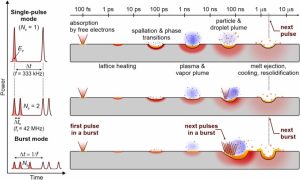
Increasing the energy of an individual ultrashort laser pulse does not necessarily lead to more efficient material removal. The maximum specific removal rate, defined as the volume of material removed per unit of energy, is achieved at relatively low laser fluences. Instead of delivering all the energy in a single pulse, it can be distributed across a sequence of pulses separated by just a few tens of nanoseconds, forming a MHz pulse burst.
The study investigated how the number of pulses within a MHz burst affects ablation efficiency when drilling thin foils of stainless steel, titanium, aluminum and copper. The researchers evaluated efficiency as the ratio of the drilling depth to the total fluence delivered by each pulse burst.
They developed a theoretical model that accounts for the fraction of energy from preceding laser sub-pulses that remains in the material as residual heat. As a result, subsequent sub-pulses interact with an already heated surface, reducing the fluence required to remove material. The model successfully captures the main trend in the experimentally determined optimum fluence as the number of pulses within a MHz burst increases.
Ablation efficiency also depends on how drilling depth changes with the number of pulses in a burst. Under ideal conditions, the logarithmic ablation-depth law predicts that drilling depth increases proportionally with the number of pulses, a behavior known as additive scaling. For stainless steel and titanium, however, drilling depth initially increases faster than predicted (super-additive scaling), consistent with additional material removal through melt ejection. At higher pulse numbers, the increase becomes slower than expected (sub-additive scaling), consistent with the redistribution and resolidification of molten material.
By combining these two effects, the researchers derived a scaling law that explains the main experimental trends well. Deviations from the model are consistent with additional processes, including shielding of the laser beam by plasma and other ablation products, re-deposition of removed material, and melt redistribution.
“This theoretical model provides an important foundation for both further research in this field and the development of new approaches to laser processing using modern ultrafast laser systems,” explains Assoc. Prof. Dr. Peter Gregorčič.
Scientific publication
Gregorčič, P., Ahmed, R., Förster, D. (2026). Ablation efficiency in MHz burst-mode ultrashort-pulse laser percussion drilling of thin metal foils. Journal of Materials Processing Technology.