



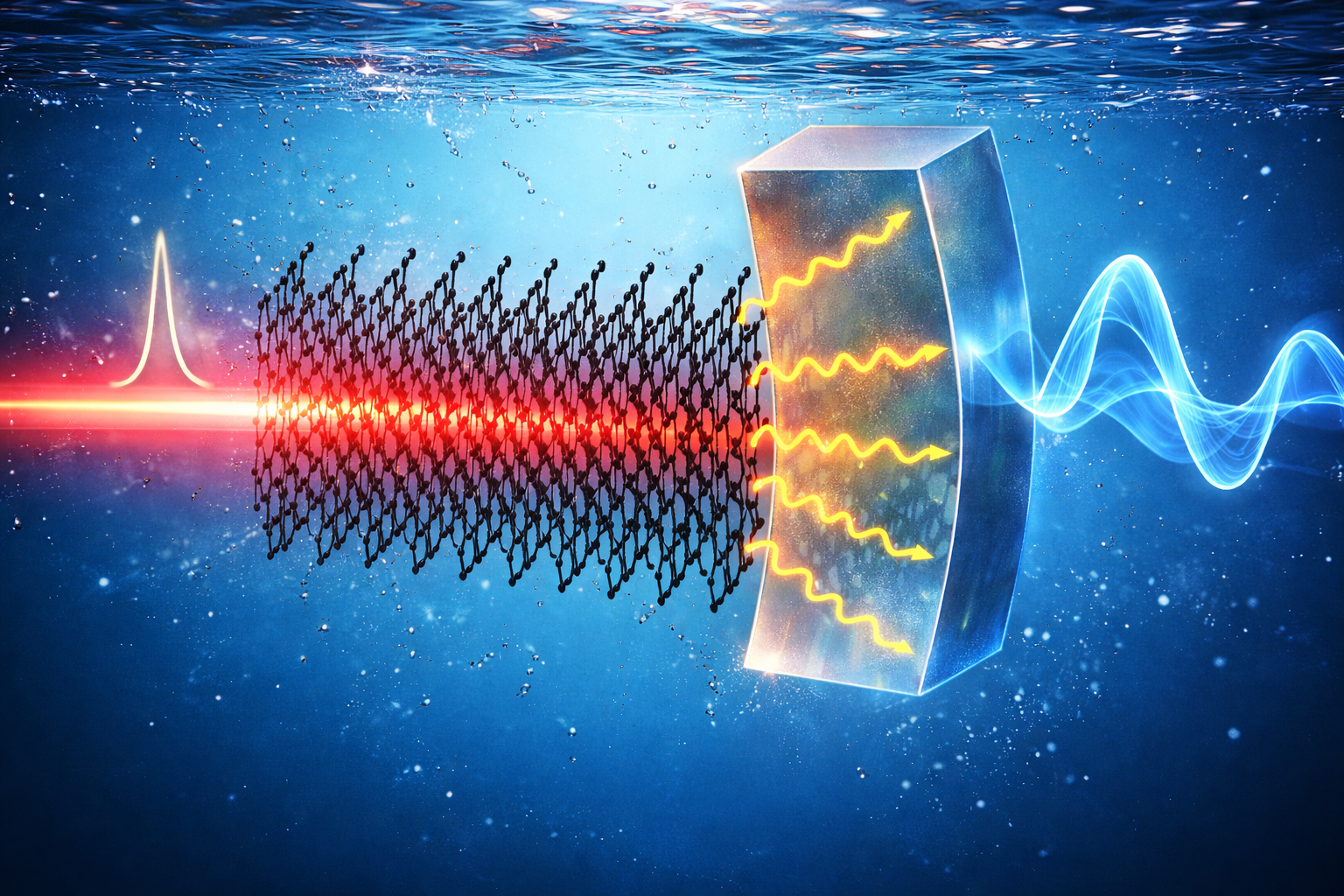
Researchers from the Laboratory for Laser Techniques (LASTEH), University of Ljubljana, in collaboration with the Jožef Stefan Institute, the University of Coimbra, and CNR-NANOTEC (Italy), have developed a graphene (GR)-based device that converts short laser pulses into high-frequency ultrasound. Reducing the number of atomic layers in graphene from 10 to 5 broadens the frequency range of the photoacoustic wave, enabling nanoscale acoustic control and supporting higher-resolution imaging as well as more precise therapeutic ultrasound. The research was realized within the Slovenian national project 2D-UltraS and Laserlab-Europe grant.
Photoacoustic (PA) technology converts short laser pulses into ultrasound. This study, published in Photoacoustics, demonstrates that chemical vapor deposition (CVD) GR, combined with picosecond laser excitation, overcomes the limitations of conventional PA generation and enables broadband, high-frequency ultrasound.
The researchers theoretically and experimentally investigated multilayer CVD-grown GR, transferred layer-by-layer onto glass and coated with a polydimethylsiloxane (PDMS) layer. To understand nanoscale photoacoustic wave generation, they developed a mesoscopic model using a continuum approach that couples thermal, mechanical, and acoustic phenomena.
Under picosecond excitation, both thermal and stress confinement conditions are satisfied, resulting in a shorter and more intense wavefront. A 10-layer CVD-GR device generated ultrasound with a bandwidth of 110 MHz at −6 dB, extending to 250 MHz at −20 dB—well beyond the limits of nanosecond excitation—and a pressure of 1 MPa for a 3.4 nm light path.
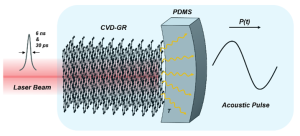
Schematic of thermoelastic acoustic generation.
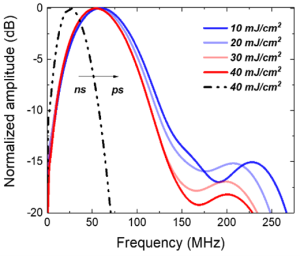
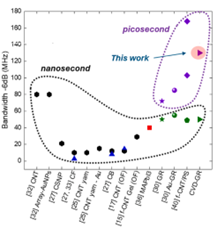
Fourier spectra of the PA signal (upper panel); comparison with the state of the art: best to date among the PDMS-based laminate composite (lower panel).
“Wafer-scale CVD-GR provides a controlled and uniform thermal interface for light-to-sound conversion. When driven by picosecond laser pulses, this architecture enables higher ultrasound frequencies and more efficient acoustic generation. By adjusting the number of graphene layers, the Kapitza resistance changes, altering heat transfer and governing interfacial temperature dynamics, which ultimately affect the PA wave profile. This led to a spectral stretch of the frequency at −6 dB up to 140 MHz,” the authors note.
CVD-GR can be produced at wafer scale and applied to various geometries, making it suitable for ultra-high-resolution imaging, precise therapies, neuromodulation, and advanced optoacoustic applications.