



Researchers from the The Laboratory for Hydraulic Machines at the Faculty of Mechanical Engineering of the University of Ljubljana, have developed a novel imaging system for flow visualization that uses 30 synchronized cameras to observe tiny ultrasound-induced cavitation bubbles from all directions. Their findings show that conventional imaging with a single camera can miss important details of bubble dynamics. The new method opens up new possibilities for a better understanding of cavitation and for improving technologies that rely on this phenomenon.
Cavitation is a phenomenon in which vapor bubbles form and grow in a liquid before rapidly collapsing. Although these bubbles exist for such a short time that they cannot be observed with the naked eye, they play an important role in technologies such as ultrasonic cleaning, wastewater treatment, and chemical processing. Understanding their behavior is therefore essential for improving the efficiency and reliability of these processes.
Until now, researchers have typically studied cavitation using high-speed cameras capturing images from one or a limited number of viewing angles. However, such recordings provide only a partial view of this complex three-dimensional phenomenon, potentially leaving important details hidden.
To overcome this limitation, researchers at the University of Ljubljana have developed an innovative imaging system that enables simultaneous observation of cavitation from all directions.
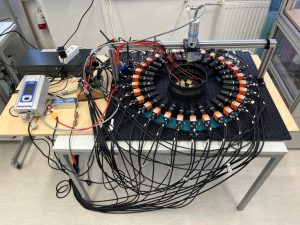
The system consists of 30 precisely synchronized cameras arranged in a circle around the small tip of an ultrasonic device that generates cavitation in water. Together, the cameras provide a complete 360-degree view, revealing complex bubble structures and asymmetries that would remain hidden when observed with a single camera. The system can also function as a virtual rotating high-speed camera, capturing the phenomenon at an equivalent frame rate of more than 60,000 frames per second. The results, published in the journal Ultrasonics Sonochemistry, also demonstrate the feasibility of reconstructing the three-dimensional shapes of cavitation structures.
“Sometimes, the best viewpoint is every viewpoint,” explains study co-author Matevž Dular, emphasizing the importance of observing these complex phenomena from multiple perspectives.

In the future, this approach could enable more accurate measurements and numerical simulations of cavitation, contributing to a better understanding and optimization of technologies based on this fascinating physical phenomenon. The imaging system also holds considerable potential for observing other small-scale phenomena in fluid flows that are difficult to capture using conventional methods, opening up new opportunities for experimental research and a deeper understanding of complex fluid dynamics.