



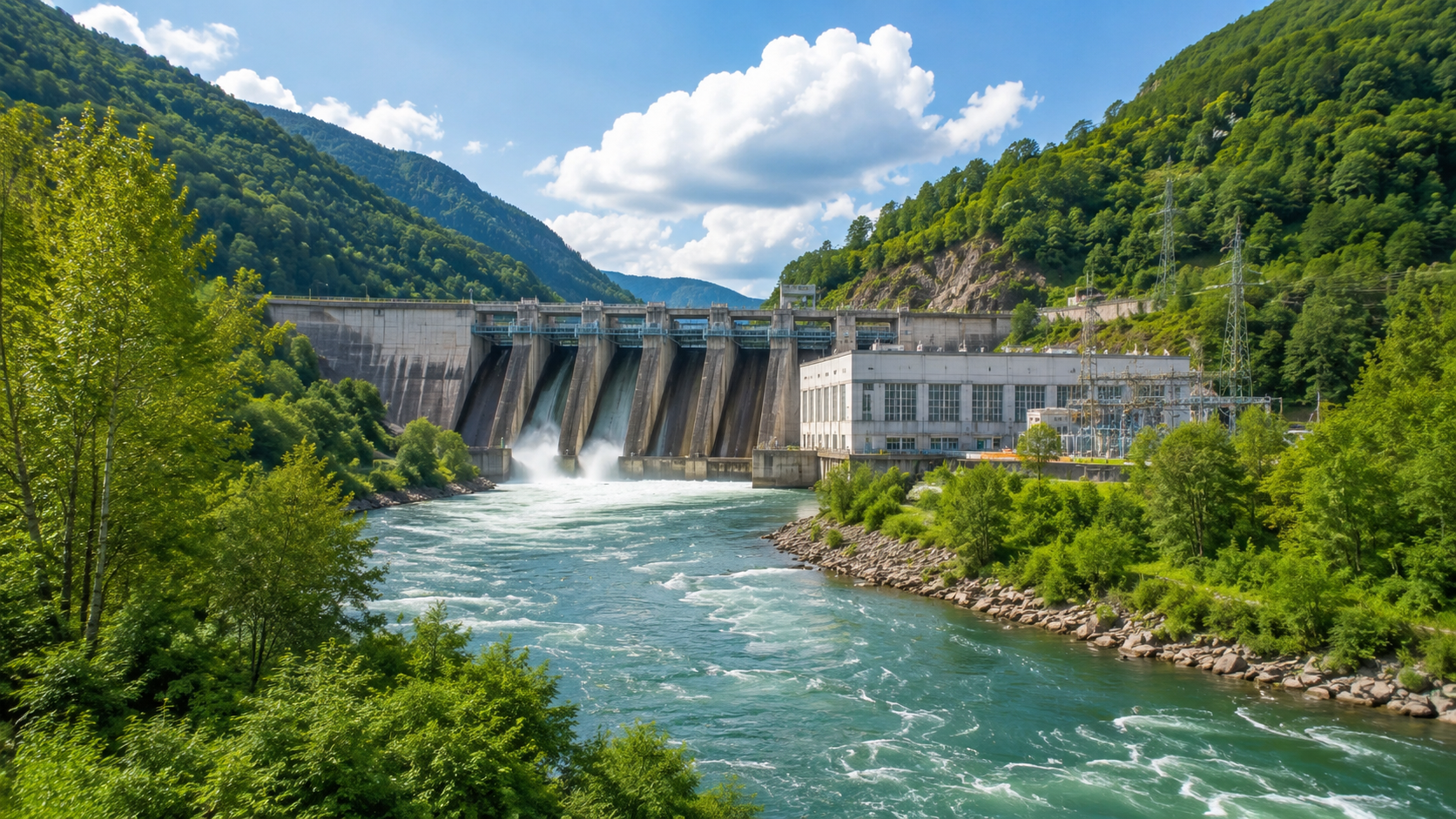
Hydropower plants of the future will need to provide greater flexibility to the electricity system while protecting aquatic ecosystems and ensuring a long service life for their equipment. These are also the main challenges addressed by the European TIES project, in which the researchers from the Laboratory for Water and Turbine Machines at the Faculty of Mechanical Engineering are leading the development of key performance indicators for evaluating hydropower plants. They are also developing advanced numerical models to predict cavitation erosion in turbines.
Hydropower plants play an important role in maintaining the stability of the electricity system because they can rapidly adjust electricity generation. However, ageing equipment, climate change and increasingly stringent environmental requirements mean that they must operate outside their conventional operating regimes more frequently. Such operation can increase mechanical loads, wear and the risk of turbine damage.
Within the European project TIES – Transforming Hydropower: Integrating Flexibility, Ecosystem Health, and Societal Needs – researchers are developing an integrated approach that brings together technical efficiency, equipment condition, water management, ecosystem health and societal impacts.
Researchers from the Faculty of Mechanical Engineering are leading a work package dedicated to defining common parameters and key performance indicators. These will enable comparisons between different operating regimes and the assessment of trade-offs between energy generation, equipment reliability, environmental impacts and the needs of local communities. The indicators will also be incorporated into digital tools supporting decision-making and the optimisation of hydropower plant operation.
An important part of the Faculty’s contribution is related to computational fluid dynamics, or CFD simulations, and the modelling of cavitation erosion. The researchers will investigate the formation and collapse of cavitation clouds, the propagation of pressure waves and the areas in which material damage may occur. The results will be used to assess the existing turbine at the Raiva Hydropower Plant in Portugal. More advanced models suitable for use in the hydraulic turbine design process will also be developed.
“Using advanced numerical models, we aim to improve the prediction of turbine damage caused by cavitation and to integrate efficiency, equipment lifetime, and environmental and societal impacts into the planning of hydropower plant operation.” — Assoc. Prof. Lovrenc Novak, TIES Project Lead at the Laboratory for Water and Turbine Machines, Faculty of Mechanical Engineering, University of Ljubljana
TIES is a research and innovation project funded under the Horizon Europe programme and will run from June 2026 to May 2030. The project is coordinated by TU Wien, and its consortium brings together 12 universities, research organisations and companies from eight European countries. The partners include EPFL, the Polytechnic University of Catalonia, the universities of Padua and Turin, as well as EDF, GE Hydro France and EDP.