



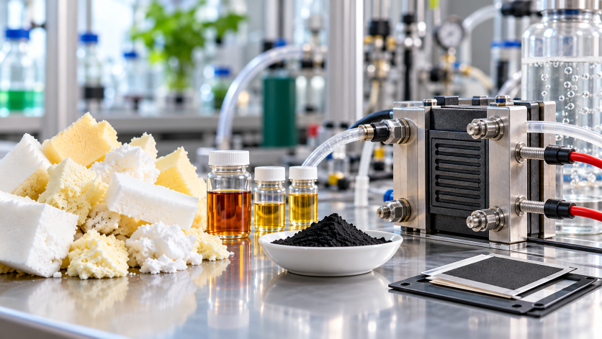
Researchers have shown how waste polyurethane foam can be converted into useful oil fractions and carbon-based electrocatalysts for the oxygen reduction reaction (ORR) in fuel cells. The Laboratory for Tribology and Interface Nanotechnology (TINT) contributed X-ray photoelectron spectroscopy (XPS) analysis of the polyurethane-derived catalysts, helping to clarify their surface chemistry. The study, co-authored by Asst. dr. Irfan Nadeem and prof. dr. Mitjan Kalin, supports more circular use of difficult plastic waste.
Polyurethane foams are widely used in insulation, furniture, transport, and consumer products, but they remain difficult to recycle efficiently. Conventional treatment routes often recover only part of the material value and miss opportunities for circular use.
The new study explores atmosphere-controlled pyrolysis as a route for upgrading polyurethane into two valuable streams: liquid products relevant for fuels, lubricants or polyol recovery, and solid carbon-rich char that can be converted into electrocatalysts. Pyrolysis was carried out at 400, 600 and 800 degrees Celsius. The char obtained at different temperatures was functionalized with iron phthalocyanine to form Fe-Nx-C catalysts for oxygen reduction in fuel cells.
The results showed that the solid fraction can be turned into active and stable catalyst materials. Adding a small share of conductive Ketjenblack carbon improved reaction kinetics, and the best-performing material showed a direct four-electron oxygen reduction pathway and stability over 2000 cycles. The liquid fraction changed with temperature: lower-temperature oils were dominated by aliphatic and polyether oligomers, while higher-temperature oil contained more nitrogen-aromatic structures with potential chemical or combustible value.
The research therefore connects plastic waste management with sustainable energy technologies: a problematic waste stream can become a source of liquid products and catalyst materials for future energy devices. A cost-benefit assessment also indicates positive socio-economic potential for this approach.
The article was published in Sustainable Energy Technologies and Assessments.
The findings point toward a broader strategy in which polyurethane waste is treated as a resource for new materials and energy applications. Future work can optimize the process and connect laboratory results with industrial recycling chains.
Polyurethane foam waste can be converted via pyrolysis into liquid fractions and carbon-based catalysts, which can be further studied for the oxygen reduction reaction in fuel cells.