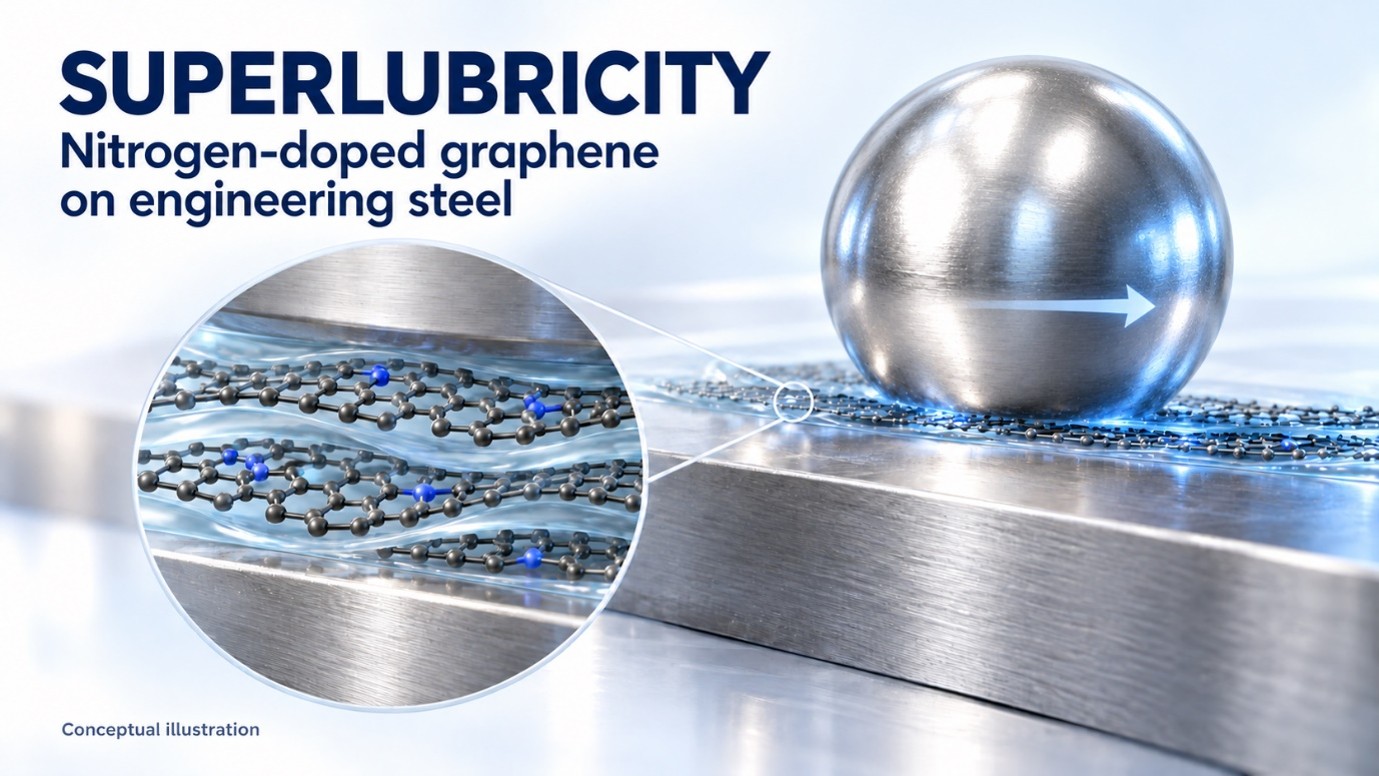
Researchers at the Laboratory for Tribology and Interface Nanotechnology, Faculty of Mechanical Engineering, University of Ljubljana, with partners at the universities of Coimbra, Maribor and Leeds and Slovenia’s National Institute of Chemistry, have achieved durable superlubricity on engineering steel. Nitrogen-doped graphene in a water-based lubricant promotes tribochemical reactions that form a protective film, offering prospects for lower energy losses and longer component life.
Friction and wear have been estimated to account for 23% of global energy consumption. Superlubricity, a state of vanishingly low friction with a coefficient below 0.01, offers a route to reducing these losses. Achieving it on engineering steel is particularly valuable because steel is widely used in transport and industrial machinery.
Published in Carbon, the study demonstrates superlubricity between steel surfaces with just 0.050 wt% nitrogen-doped graphene nanosheets in a water-based lubricant. An optimum concentration of 0.075 wt% provided the lowest friction, with coefficients reaching 0.003 under the tested sliding conditions.
Tribochemistry, the chemical reactions activated by sliding, is central to this behaviour. Surface analyses support a mechanism in which the nanosheets interact with iron species on steel, creating anchoring sites containing iron, nitrogen and carbon. Continued shearing transforms the adsorbed nanosheets into a disordered graphitic film that protects the steel and permits easy sliding. Fresh nanosheets from the lubricant help sustain this film.
Robustness tests showed rapid recovery of superlubricity after a 62-hour pause and stable performance through repeated starts and stops as loads and speeds varied within the tested range. A separate ten-hour test maintained an average friction coefficient of about 0.004 after running-in, with very low wear and no additional lubricant. This resilience matters for industry: machines repeatedly stop, restart and change operating conditions, which can disrupt lubrication and accelerate wear. Maintaining low friction and surface protection through these transitions could extend equipment life and reduce energy use and maintenance.