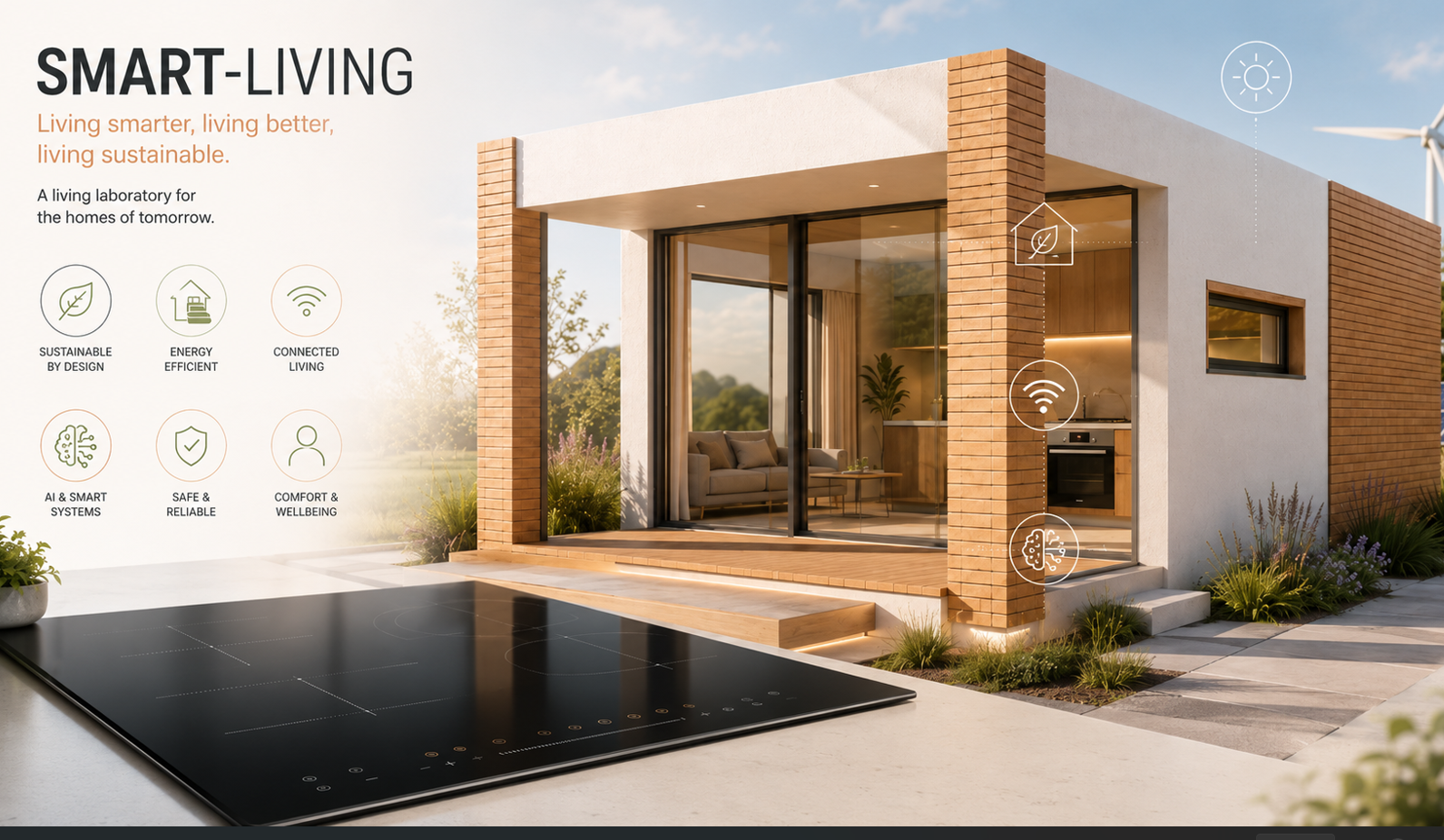
The smart buildings of the future will do more than use energy efficiently. They will adapt to their occupants, enhance their safety and well-being, and reduce their environmental impact. This is the ambition behind SMART-LIVING – Smart, Sustainable Modular Innovations of the Future for Quality Living, a research and development programme bringing together research institutions and industry to develop new technologies for sustainable, healthy and high-quality living.
Buildings account for a substantial share of global energy consumption and have a major impact on both quality of life and the environment. Against the backdrop of climate change, rising energy costs and growing expectations for comfortable living environments, smart and sustainable buildings are becoming an increasingly important area of development. Conventional approaches to building design, construction and operation are often no longer sufficient to meet these challenges.
SMART-LIVING brings together research institutions and leading Slovenian companies to develop a new generation of modular, energy-efficient and digitally enabled buildings. At the heart of the programme is the “four zeros” concept: zero emissions, zero net energy consumption, zero health and safety risks, and zero stress for occupants. Research will cover advanced building materials, energy systems, digital twins, artificial intelligence, cybersecurity and circular-economy approaches.
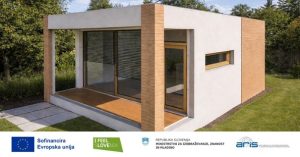
The programme comprises eight interconnected research and development projects, ranging from research and technology development at Technology Readiness Levels (TRL) 3–4 to the development of prototypes and solutions at TRL 5–6. The resulting prototypes will be integrated into a full-scale demonstration building at the testing site of industrial partner REM d.o.o. in Trebnje. This will enable solutions for smart, sustainable, circular and health-conscious living to be tested and evaluated under real-world conditions.
Key role of the University of Ljubljana, Faculty of Mechanical Engineering
The University of Ljubljana, Faculty of Mechanical Engineering contributes expertise in thermal engineering, energy systems, intelligent decision-support methods and predictive maintenance. The Laboratory for Refrigeration and District Energy (LAHDE) and the Laboratory for Digitalisation of Structural Dynamics (LASDi) are both involved in the research. Their researchers will develop advanced methods for optimising energy systems, monitoring building performance and using artificial intelligence to predict building operation and performance.
“Through SMART-LIVING, the University of Ljubljana, Faculty of Mechanical Engineering contributes key expertise in thermal management, energy systems, structural dynamics and intelligent methods for predictive maintenance. Our role is particularly important because we bridge fundamental research with prototype development, helping pave the way for smarter, more energy-efficient and user-friendly buildings of the future,” said Prof. Dr. Gregor Čepon of the Laboratory for Digitalisation of Structural Dynamics (LASDi).
From research to market-ready solutions
The programme will deliver prototypes that can serve as a foundation for the development of final products and their subsequent large-scale production. Throughout the development process, researchers and industry partners will assess product performance, identify potential manufacturing challenges and examine end-of-life options for the products in line with circular-economy principles.
SMART-LIVING began on 1 May 2026 and will run until 30 April 2029. The programme is led by the University of Ljubljana, Biotechnical Faculty. The consortium also includes the University of Ljubljana, Faculty of Mechanical Engineering; the University of Ljubljana, Faculty of Electrical Engineering; the University of Maribor, Faculty of Electrical Engineering and Computer Science; the Slovenian National Building and Civil Engineering Institute; and the companies GORENJE, REM, DANFOSS TRATA, M SORA, SMARTIS, JUB and PIKTRONIK.
The total value of the SMART-LIVING programme is EUR 8,229,230.20, of which EUR 4,999,780.68 is provided by the European Regional Development Fund. The programme is co-funded by the European Regional Development Fund under the European Cohesion Policy Programme 2021–2027.
The technologies and prototypes developed through SMART-LIVING will contribute to more sustainable buildings, greater energy efficiency and independence, and safer, healthier and more user-friendly living environments.
More information on European Cohesion Policy is available at evropskasredstva.si.